The Colosseum: How Rome Built Its Greatest Arena in Under 10 Years
Ancient Rome drained an emperor's private lake and used 100,000 workers to erect the world's largest amphitheater in under a decade — complete with 80 hydraulic elevators and a navy-operated retractable roof.
The Colosseum: How Rome Built Its Greatest Arena
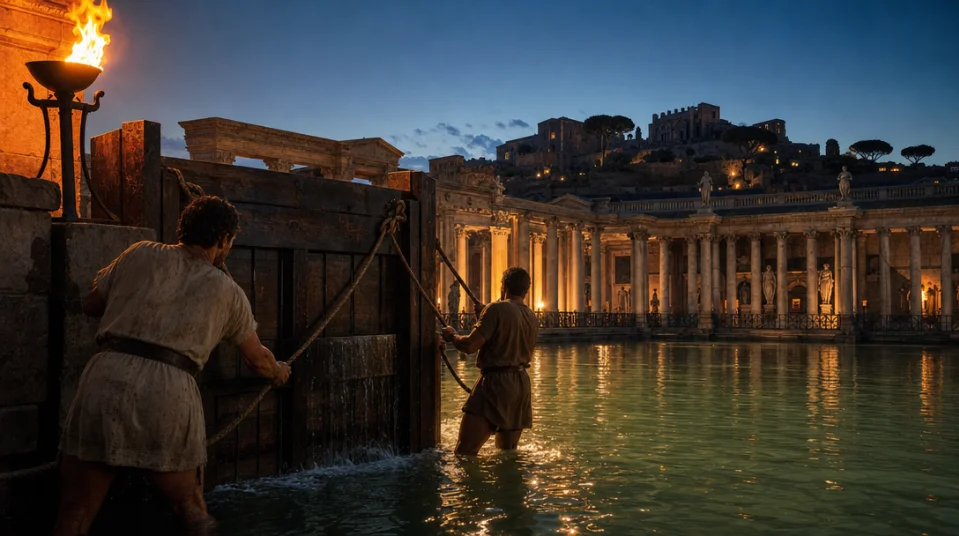
Built between AD 72 and 80, the Colosseum stands as one of humanity's most astonishing engineering feats. Emperor Vespasian began construction by draining the artificial lake from Nero's private estate — a calculated political move to reclaim land for the public.
Key Construction Facts
- Materials: 100,000 cubic meters of travertine limestone hauled from quarries 20 miles away via a purpose-built road; iron clamps held the stones together — no mortar
- Roman Concrete: Volcanic ash (pozzolana) mixed with seawater created a self-hardening underwater concrete that is still stronger today than modern Portland cement
- Scale: 188 meters long, 156 meters wide, 48 meters tall — the largest amphitheater ever built
- Workforce: An estimated 100,000 workers, including Jewish prisoners of war following the Siege of Jerusalem
- Speed: The entire structure completed in under 10 years
Hidden Engineering Marvels
Beneath the arena floor lay the Hypogeum — a labyrinth of underground corridors and 80 hydraulic elevators that lifted wild animals and gladiators directly onto the arena floor. The retractable awning (velarium) shaded up to 50,000 spectators, operated by sailors from the Roman navy.
The Grand Opening
Emperor Titus inaugurated the Colosseum in AD 80 with 100 consecutive days of games. Ancient sources record over 9,000 animals killed during the inaugural festivities alone.
Legacy
Nearly 2,000 years later, the Colosseum attracts over 7 million visitors annually. Its three-tier façade of Doric, Ionic, and Corinthian columns directly influenced arena and stadium architecture worldwide — from Madison Square Garden to the Bird's Nest in Beijing.
Add more perspectives or context around this Drop.